How to use the circle of fifths: learn chords by hearing them
The circle of fifths arranges all 12 keys around a single circle. It shows key signatures, how keys relate to each other and how chord progressions work, all at a glance, which helps whether you’re reading a score or working out an accompaniment or arrangement. This article walks through how to read it, then diatonic chords, common progressions, secondary dominants and borrowed chords.
This article is written by NOURETE, the maker of the sheet music app Scorevell. How to use it in the app is covered at the end, under “In Scorevell.”
What the circle of fifths is
C major sits at the top. Each step clockwise goes up a perfect fifth: C → G → D → A → E → B → F♯, and after 12 steps you are back at C. Going counterclockwise moves down a fifth (up a fourth): C → F → B♭ → E♭ and so on.
Major keys go around the outside, and each one’s relative minor (the minor key with the same key signature) sits just inside it: A minor inside C, E minor inside G. At the bottom, F♯ and G♭ are the same pitch with two names (enharmonic equivalents).
Reading key signatures
Each step clockwise from C adds one sharp to the key signature (G has one, D has two … F♯ has six). Each step counterclockwise adds one flat (F has one, B♭ has two … G♭ has six).
The order in which sharps are added, F–C–G–D–A–E–B, is itself a chain of fifths. Flats are added in the reverse order: B–E–A–D–G–C–F.
Finding the key from a signature:
In a sharp key, the major key is a half step above the last sharp (three sharps end on G♯, so it’s A major). In a flat key, the second-to-last flat names the key (three flats are B♭, E♭, A♭, so it’s E♭ major). One flat is F major, which you simply memorize.
Neighbors are closely related keys
Keys next to each other on the circle differ by only one note: C major and G major differ only in F versus F♯. That’s why, when a piece changes key (modulates), it often moves to the dominant key on the right, the subdominant key on the left, or the relative minor inside. When a run of accidentals shows up in your music, check whether it has moved to a neighboring key on the circle.
Diatonic chords on the circle
Chords built only from the notes of a key’s scale are called diatonic chords. In C major there are seven. Roman numerals show which scale degree each chord is built on; uppercase is major, lowercase is minor.
| Degree | I | ii | iii | IV | V | vi | vii° |
|---|---|---|---|---|---|---|---|
| C major | C | Dm | Em | F | G | Am | Bdim |
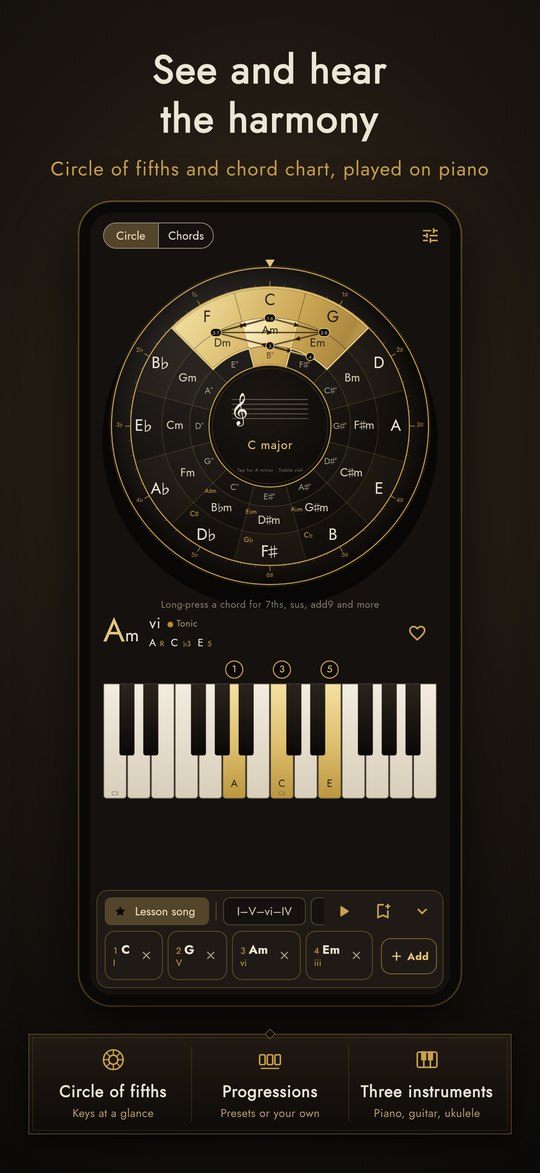
Find them on the circle: I (C) has IV (F) and V (G) on either side, with ii (Dm), vi (Am) and iii (Em) just inside. Six of the seven sit together in the highlighted area above. The shape is the same in every key, so just rotate that area to find the most-used chords in any key.
Chord functions (T, S, D)
- Tonic (T): stable, at rest. Centered on I; vi does the same job.
- Subdominant (S): moves away from the tonic. IV and ii.
- Dominant (D): pulls back toward the tonic. V and vii°.
iii can stand in for the tonic or the dominant. Many progressions follow the flow T → S → D → T.
Common chord progressions
| Name | Degrees | In C major |
|---|---|---|
| — | I–V–vi–IV | C–G–Am–F |
| ’50s progression | I–vi–IV–V | C–Am–F–G |
| Two-five-one | ii–V–I | Dm7–G7–Cmaj7 |
| Canon progression | I–V–vi–iii–IV–I–IV–V | C–G–Am–Em–F–C–F–G |
| Royal Road (common in Japanese pop) | IV–V–iii–vi | F–G–Em–Am |
Trace ii–V–I on the circle and it moves D → G → C, one step counterclockwise each time. Roots falling by fifths make a very strong connection between chords, and that motion is the backbone of countless pieces, not only jazz. In minor keys, i–iv–v–i (Am–Dm–Em–Am) and the Andalusian cadence i–♭VII–♭VI–V (Am–G–F–E) are common.
Secondary dominants
A secondary dominant treats another chord as a temporary tonic and puts that chord’s V (usually V7) in front of it. It’s written with its target, as in V/V (“five of five”).
| Symbol | Chord in C major | Resolves to |
|---|---|---|
| V/ii | A7 | Dm |
| V/iii | B7 | Em |
| V/IV | C7 | F |
| V/V | D7 | G |
| V/vi | E7 | Am |
On the circle, the root of a secondary dominant is one step clockwise from the root of its target. In C–A7–Dm–G7–C, the C♯ in A7 isn’t in C major, so the color of the sound shifts and it pulls strongly toward the Dm that follows.
Borrowed chords
Borrowed chords come from the parallel key, the key with the same tonic. In C major, you can borrow iv (Fm), ♭VI (A♭), ♭VII (B♭) and ♭III (E♭) from C minor. F–Fm–C (IV–iv–I) and A♭–B♭–C (♭VI–♭VII–I) are familiar examples.
On the circle, these chords cluster to the left of the highlighted area, on the flat side. Play them and listen for the brief shadow of minor inside a bright major key.
Tips for learning
- Listen as you play: link each name to its sound, and chord symbols in your music will start to sound in your head.
- Go around the circle one key at a time: once a progression works in one key, play it in the next. It doubles as transposition practice.
- Write Roman numerals in your music: label the chords in a piece you’re learning, and the same shapes start to stand out in any key.
In Scorevell
Scorevell’s Harmony screen lets you try everything above with sound. The circle of fifths and chord chart are free.
- Turn the circle to change key and see the chords that belong to it.
- Tap a chord to hear it on piano. Long-press for 7ths, sus, add9 and more.
- See how to play it on piano (with inversions and fingering), guitar or ukulele.
- Use Overlays to show functions (T·S·D), secondary dominants (with arrows to where they lead), borrowed chords and church modes on the circle.
- On the Chords tab, look up a chord by root and type, or tap keys to find a chord’s name.
- Pick from nine major and minor preset progressions, including I–V–vi–IV, ii–V–I, I–vi–IV–V, the Canon progression and the Royal Road. Tap ▶ (Step through) to hear each chord on piano while the progression is traced on the circle. Save up to 30 progressions of your own, with names.
- With a score open, tap Harmony in the toolbar to open it in that piece’s key. “Use as this piece’s key” saves the current key to the score details.
- In Chord practice, play the chord shown to learn it. In Chord Rush, see how many chords you can play in 15 seconds, and sign in to join the world ranking. You can also connect a USB MIDI keyboard. Choosing your own chords for practice is a Pro feature.
Summary
The circle of fifths puts key signatures, related keys, common chords and progressions on one circle. Start by learning the six-chord area for C major, then rotate it and play the same progressions in other keys. Once sound and shape connect, the chords in your music get much easier to read.
See Scorevell on the App Store
As of October 2026. For iPhone and iPad (iOS/iPadOS 15.5 or later).